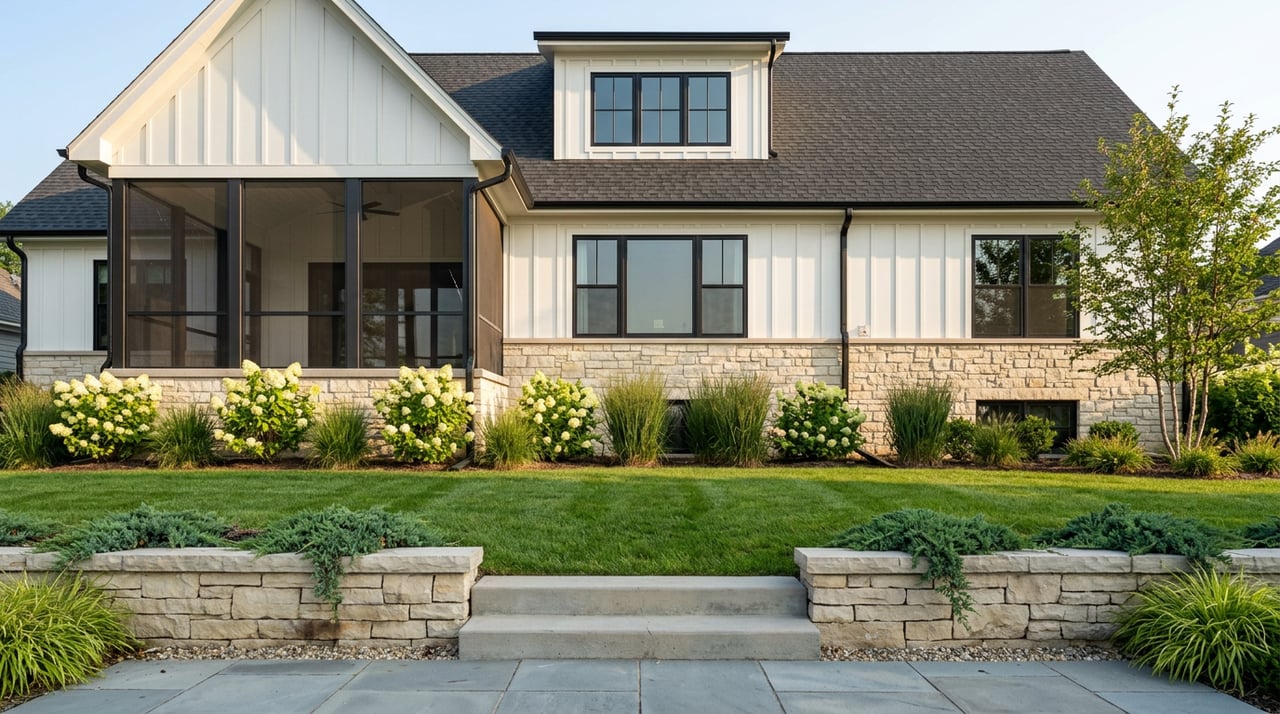
If you are shopping a spec home in Brookshire, a Brandl Anderson plan at Reserve at Cedar Creek or Summers Creek, or a Pulte, Lennar, or D.R. Horton floor plan somewhere along Cedar Avenue, the sales counselor will hand you a stack of paper that looks a lot like a resale purchase agreement. It is not. The base price on the sign is the line item you are least likely to move. Everything meaningful for a Lakeville buyer in 2026 lives in the addenda, the lender language, and the fee-schedule pass-throughs.
That gap between what buyers think they are negotiating and what actually flexes is the reason two neighbors on the same street can close on nearly identical homes with very different real costs.
The base price is the anchor. The addendum, the preferred-lender incentive, and the city fee pass-throughs are the room.
The builder's paper is not the MN Realtors form
Most Lakeville resale deals ride on the Minnesota Realtors Residential Purchase Agreement. New construction has its own form, and the larger production builders swap even that out for a proprietary contract drafted by their own counsel. The Minnesota Realtors New Construction Purchase Agreement itself is telling on this point: if the buyer cannot secure the financing specified and does not close on the specified date, the purchase agreement is canceled, buyer and builder sign a cancellation directing earnest money to be handled per the contract, and in some scenarios earnest money is forfeited to the builder.
That forfeiture line is the one buyers gloss over. On a resale, a failed financing contingency almost always returns earnest money. On a new build, especially with a builder-drafted addendum layered on top, the path to a refund is narrower and the deposits are larger. Semi-custom builders in Lakeville routinely ask for five percent down at signing and then a second deposit at design-center selections. Both can be at risk if the deal breaks over financing after the contingency window closes.
Read the addendum for three specific mechanics before you sign:
- Delay language. Weather days, supply delays, and municipal inspection backlogs typically extend the builder's completion date without penalty. Your rate lock does not extend with it.
- Change-order authority. Once selections are finalized, unilateral buyer changes usually trigger a fee plus a schedule reset. Builder-initiated substitutions of "equivalent" materials often do not require your consent.
- Assignment and resale restrictions. Some builders prohibit listing the home for resale for a set period after closing, which matters if you are an investor or if life plans shift.
Where the 5-day loan-application clock actually points
The MN Realtors New Construction form sets a tight window: mortgage application is to be made within five business days after the final acceptance date of the purchase agreement. Builders enforce this because their construction financing depends on knowing you will close.
Here is where the incentive structure gets interesting. National builders active in Lakeville, including Pulte, offer meaningful concessions when buyers use in-house lending. Pulte markets that its finance specialists guide buyers through the process, with townhomes starting from the mid $300Ks, and the rate buydowns and closing-cost credits typically ride on using that in-house channel. D.R. Horton and Lennar run similar programs.
The buydown numbers matter more this year than last. National 30-year fixed averages were near 6 percent in February 2026, based on Freddie Mac's weekly survey, and Twin Cities forecasts have put the working range for most buyers at 6 to 7 percent. A builder that buys your rate down 1.5 points on a $500,000 loan is handing you more monthly value than a $10,000 price cut. What you give up is the ability to shop the loan honestly. Get a written estimate from an outside lender before you sign anything, so the incentive is a real comparison rather than a suggested one.
Statutory warranties: what 1/2/10 actually covers
Minnesota is one of the more buyer-friendly states on new-home warranties, but the coverage is narrower than most buyers assume. Minnesota law requires that a seller of new homes must provide certain warranties to the purchaser, and the durations follow the familiar 1/2/10 framework written into Chapter 327A.
| Coverage | Duration | What it typically addresses |
|---|---|---|
| Workmanship and materials | 1 year | Finish work, trim, drywall, paint, minor systems |
| Plumbing, electrical, heating, cooling, ventilation | 2 years | Distribution systems inside the home |
| Major structural defects | 10 years | Load-bearing components that make the home unsafe or unlivable |
The tail on the structural piece is longer than most people realize. For an action under Minnesota Statute Section 327A.05 that accrues during the ninth or tenth year after the warranty date, an action may be brought within two years of the discovery of the breach, but in no event may an action be brought more than 12 years after the effective warranty date. In practical terms, structural claims discovered in year ten can still be pursued into year twelve.
What the statute does not cover is the daily-life stuff. Cabinet alignment, grout cracks, and the settling drywall seam above the great-room window fall under the one-year workmanship window. Document these at your final walkthrough or you will be arguing about them at month thirteen.
The 2026 fee schedule now rides in the base price
Lakeville's development costs adjust annually, and the current numbers hit contracts signed this year. The Lakeville City Council on December 1 held a public hearing and adopted an ordinance revising the city's fee schedule for permits, planning and engineering fees, connection charges and other development fees, with park shelter rental fees updated after a market comparison with nearby cities. Those permit and connection charges do not appear as a separate line on your closing disclosure. They are absorbed into the base price and lot premium.
Park dedication is the other quiet cost. The Park Dedication Fund is sustained through required Park Dedication Fees that developers must contribute at the completion of a new development, satisfied through a cash contribution, land dedication, or a combination of both. In practice, that fee shows up in your lot premium in newer subdivisions where the developer paid cash rather than dedicating land. Avonlea worked differently, where land ownership was conveyed at the time of final plat to satisfy the developer's park dedication contribution requirement, which is one reason lots inside Avonlea and comparable phased communities can price differently than a stand-alone infill build.
None of this is negotiable at your kitchen table. It is worth knowing so you understand why the Lakeville base price for a comparable floor plan runs higher than the same builder's product in a farther-out community.
Reading the softer resale market as buyer leverage
Here is the part that changes how you should sit at the sales table. The Lakeville resale market has cooled. Over the three months ending May 2026, 55044 home prices were down 0.26 percent compared to the same period last year, selling for a median of $524,000, with homes selling after 33 days on the market compared to 29 days last year, and 259 homes sold in May this year, up from 246. Zillow's index tells the same story from a different angle, showing the average Lakeville home value at $467,503, down 0.8 percent over the past year, going to pending in around 15 days.
When resale slows, builder spec inventory becomes the pressure point in the market. Builders carry construction loans on unsold homes and pay interest every month the home sits. That is why the aggressive concession right now is on completed or near-completed spec homes rather than on to-be-built floor plans where the builder has not yet broken ground. If you are flexible on plan and lot, a completed Robert Thomas Homes spec in Brookshire or a Brandl Anderson spec at Reserve at Cedar Creek is where the real number lives.
Ask specifically about:
- Rate buydowns tied to a fixed dollar cap rather than a fluctuating point structure
- Design-center credits applied to structural upgrades already installed in the spec
- Closing-cost credits that do not require the in-house lender
- Appliance or landscaping packages added after contract
The pre-closing walkthrough is not a home inspection
Buyers of resale homes hire an independent inspector during the inspection contingency and negotiate repairs from the report. New-construction buyers often skip this step because the home is new. That is a mistake worth about $500 to avoid.
An independent third-party inspection scheduled before drywall and again before your final walkthrough catches items the builder's own quality assurance walk misses, and it gives you leverage against the workmanship warranty later. Bring the report to your builder walkthrough and put every open item on the punch list in writing. Items not on the written punch list are hard to recover after closing, because the closing itself is treated as your acceptance of condition.
A short punch list before you sign
- Get an outside mortgage estimate before you commit to the builder's preferred lender, so the incentive is measurable
- Read the delay and rate-lock language together, not separately
- Ask for the full 2026 fee-schedule breakdown by line item, even if it is embedded in base price
- Confirm whether earnest money is refundable if the builder misses the outside completion date
- Schedule an independent inspection before drywall and before final walkthrough
- Document every workmanship item in writing during the one-year window
New construction in Lakeville is still one of the better paths into a first or move-up home this year, especially with resale inventory sitting longer and builders motivated to move standing product. The value is real. It just does not live where the marketing points.
If you are close to signing on a Lakeville build, or trying to decide between a spec home and a resale a mile away, that is exactly the conversation to have before the paper moves. Nicholas Thull Real Estate works new-construction transactions across Lakeville every week and can review a builder addendum with you line by line. Let's connect.